For emergencies:
Call 1800 372 999

In our Networks for Net Zero strategy, ESB Networks has committed to delivering a net zero ready electricity distribution network by 2040 to enable Ireland to achieve its legally binding net zero target by 2050. A key action in our strategy is to publish a ten-year Distribution Network Development Plan (DNDP) as required under the Clean Energy Package Directive (EU) 2019/944.
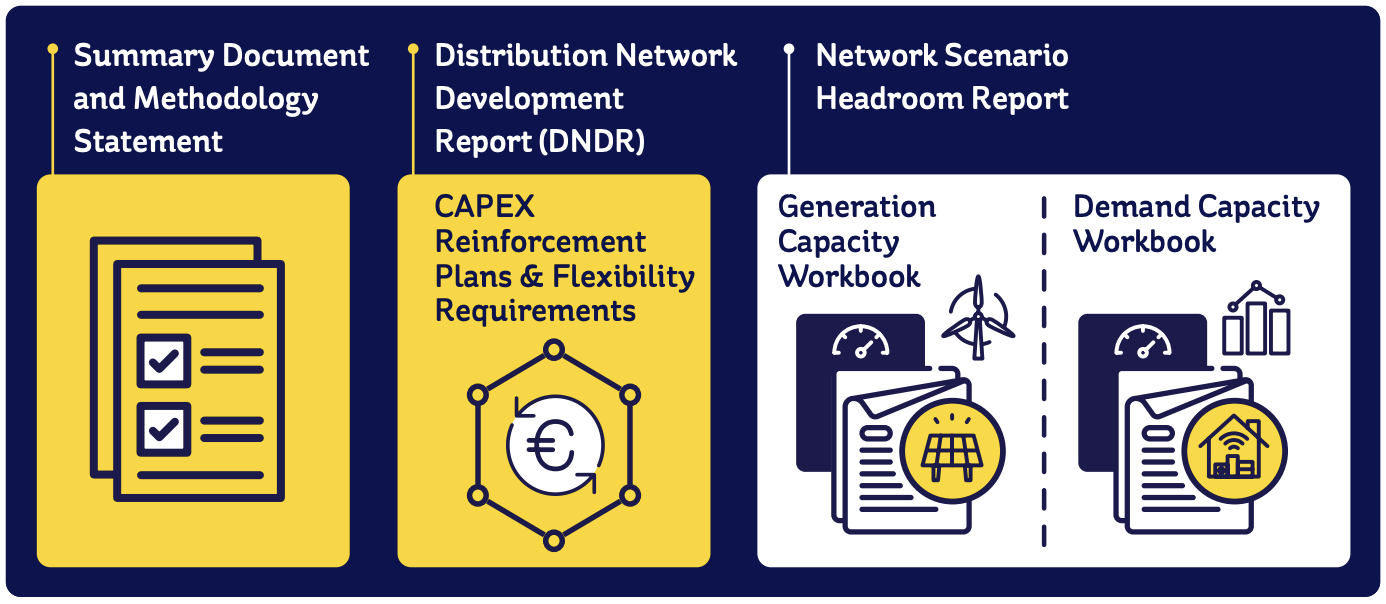
The DNDP consists of the following suite of documents:
Part 1: A Summary Document and Methodology Statement.
Distribution Network Development Plan Part 1- Summary Document and Methodology Statement
Part 2: A Distribution Network Development Report (DNDR) providing detailed information on investment projects in each distribution network area that will add capacity.
Distribution Network Development Plan Part 2 - Distribution Network Development Report
DNDP consultation and response
A consultation was held in Q3 2025, please see our response to our stakeholders below.
ESB Networks Distribution Network Development Plan Consultation Summary Responses
Network Scenario Headroom Report
The Network Scenario Headroom Report (NSHR) consists of two capacity workbooks for both demand and generation on the distribution system. The publication of these workbooks marked the first step in our plan to publish the Distribution Network Development Plan (DNDP). Publication of the DNDP is a requirement of EU Directive (2019/944) which stipulates that Distribution System Operators should publish a Network Development Plan every two years. The purpose of the plan is to provide a useful source of information on the future plans for reinforcement and flexibility service needs on our electricity network.
Please see below the Demand Capacity Headroom Report 2025. The Generation Capacity Headroom report is due for publishing in Q1 2026.
Note: Users should download a copy of the workbooks to a local drive in order to use the workbooks effectively.
Generation Capacity Headroom Report 2025
Demand Capacity Headroom Report 2025
Disclaimer
The capacity workbooks provide an indication of the available transformer capacity at substations. It does not guarantee the same capacity is available in the upstream networks such as the 38 kV network feeders or transmission system bulk supply points. It cannot be relied upon in isolation to assess the viability of a connection to a premises. Whilst we use reasonable endeavours to ensure that the capacity workbooks and related information are accurate, we do not warrant, and do not accept any responsibility or liability for, the accuracy or completeness of the content or for any consequence or loss which may arise from reliance on the capacity workbooks or related information. The available capacity figures will be updated annually. The legal disclaimer terms and conditions for use of our website apply to the capacity workbooks and related information.
Frequently asked questions
What is the Demand Capacity Workbook?
This workbook provides indicative "headroom" capacity available for new demand connections at existing 110 kV and 38 kV substations. Forecasts are produced for every year up to 2030, and then for every five years after that out to 2050. The workbook indicates the spare or “headroom” capacity available at a station under four different growth rate scenarios. Note that the information provided is indicative. There can be upstream network limitations on High Voltage (HV) feeders and transmission system feeders that will limit capacity at local substations. In order to secure capacity for a new connection, customers are advised to follow the new connection application process available on the ESB Networks website www.esbnetworks.ie.
What reinforcements are included in the Capacity Workbooks?
Demand Capacity Headroom Report 2024 included projects that are planned for the Price Review 5 (PR5) period to 2025. Demand Capacity Headroom Report 2025 includes reinforcement projects planned for the PR6 period to 2030.
What is the Price Review (PR) period?
Every 5 years ESB Networks make a submission to the Commission for the Regulation of Utilities (CRU) to outline the expenditure needs on the distribution network. The PR6 period runs from 2026 to 2030. The CRU issued the determination for the PR6 period on 16th December 2025.
What is the Generation Capacity Workbook?
This workbook provides indicative "headroom" capacity for new generator connections available at existing 110 kV and 38 kV substations. Forecasts are produced for every year up to 2030, and then for every five years after that out to 2050. The workbook indicates the spare or “headroom” capacity available at a station under four different growth rate scenarios. Note that the information provided is indicative .There can be upstream network limitations on High Voltage (HV) feeders and transmission system feeders that will limit capacity at local substations. In order to secure capacity for a new connection customers are advised to follow the new applications process available on the ESB Networks website
What is firm and non-firm capacity?
Firm capacity is the capacity that a HV station can sustain over a prolonged period under both normal feeding operation and during an outage due to a fault or maintenance of a transformer at a station. Non-firm capacity is additional capacity in excess of the firm capacity that could also be provided at a station. During an outage of a transformer, non-firm capacity is available if there are adequate load transfer arrangements in place to transfer demand to adjacent stations or there is flexible load at the station that can be used to reduce demand within the required timeframe.
What are the growth scenarios?
Four growth rate scenarios are presented in the workbooks, conservative, base, aggressive and best view. These scenarios are based on different assumptions for growth of the existing and future load, economic and commercial growth, electrification of transport and heat and new housing developments. There is a degree of uncertainty around predicted growth rates as they are dependent on a number of factors such as the rate of economic growth, rate of new housing construction and the rate of adaption of electrification of heat and transport targets under the Climate Action Plan (CAP). The Base case aligns with the CAP targets.
How often will the capacity workbooks be updated?
The capacity workbooks will be updated on an annual basis.
What is the Distribution Network Development Plan (DNDP) and when will it be published?
The draft DNDP was published in August 2025 and the final version published in December 2025. The DNDP consists of the network scenario headroom report (capacity workbooks) in conjunction with a Distribution Network Development Report (DNDR) and accompanying Methodology document. The aim of the DNDP is to provide transparency to customers on the medium-term and long-term development plans for the network. The Distribution Network Development Report (DNDR) outlines the infrastructure CAPEX reinforcement plans and also indicates areas of the network where flexibility services will be required.
How do I secure capacity for my connection?
Customers are encouraged to engage early with ESB Networks if they are planning a new development that will require a connection to the electricity network.
To secure capacity for a new connection customer are advised to follow the new applications process available on the ESB Networks website
ESB Networks' network planners must carry out a detailed network study for each application before a connection is issued.
Where can I find further information on ESB Networks flexibility products and services?
For more information please refer to this page flexible demand.
How is the headroom capacity at a station calculated?
- An example is provided for a typical 38 kV/MV substation.
- A typical configuration of a 38 kV station in an urban setting is that two 10 MVA transformers are installed.
- For this 2x10 MVA station, the total installed capacity is 20 MVA, the firm capacity is 15 MVA and the non-firm capacity is 18 MVA.
- When a fault on a transformer occurs, there is a single transformer remaining operational in the station. This is referred to as an N-1 scenario.
- Subsequent to an N-1 fault on a 10 MVA transformer, the remaining transformer can be loaded up to 180% (18 MVA) of its capacity for a short period. Load must be transferred by operational switching on the MV system to adjacent stations to reduce the load to 15 MVA (150%). The transformer can carry this 15 MVA on a cyclic basis for a number of days until the second transformer is repaired or replaced. This is the firm capacity of the station.
- If the peak demand on the 38 kV station is 10 MVA, the capacity workbooks will indicate that there is 5 MVA of firm capacity or 8 MVA of non-firm capacity available at the station.
What does it mean if I see a negative result for capacity at a station?
- The firm and non-firm capacity results are based on a scenario where one transformer in a standard two-transformer station arrangement has a fault outage at the peak system demand.
- The peak system demand generally occurs around the 5pm to 7pm period on a winter evening in December or January and is the most onerous or “worst-case” scenario.
- Maintenance outages are generally planned to occur when loads on the system are lower.
- In general, transformers are operating normally and faults at the system peak are a rare occurrence.
- In the event of a fault occurring, load can generally be transferred away to adjacent stations in order to reduce the loading on a transformer.
- If workbook indicates that a 38 kV/MV (2x10 MVA) station has a negative firm capacity (-3 MVA), this means there is 18 MVA on the station at peak time.
- This means that at peak time December/ January there is usually 9 MVA peak demand on each 10 MVA transformer.
- This is not a problem generally.
- The issue only arises if you get a fault at 6pm, within 30 minutes you must reduce load to 15 MVA (firm capacity 150%) and then this can be carried for a number of days
- However, a negative result for headroom capacity is a good indicator that there is a requirement for a new network reinforcement project to add capacity to the network and facilitate further customers connections.
What is the difference between the capacity heatmap and the capacity workbooks?
- The capacity heatmap provides an indication of the capacity available on the network at the current point in time. The data reflects recent customer application data that will utilise capacity at HV/MV or MV/LV substation. They do not provide a future projection based on growth rates. The capacity heatmaps are updated regularly throughout the year and can be found here: availability capacity heatmap
- The Network Scenario Headroom Report (capacity workbooks) are a separate tool and provide a projection into the future of the headroom capacity at a HV substation based the peak demand figure of 8th January 2025 and the application of the different growth rate scenarios at each substation.
- Hence there can be differences in the results at a substation due to the different assumptions used in each.
- Both tools are to be used as indicative guides for customers.

Contact us
If you have any feedback or comments on the headroom capacity workbooks please contact us at the following email address development.plans@esbnetworks.ie